Remembrance and Meditation

As I write this, I am aware of the changing weather. But snow is not yet in the forecast. More often than not, it is already on the ground by November 10th. A hint of a smile emerges as I await the first blanket of white, which always seems to instill a deep sense of peace within me.

Monday, November 11th, is Remembrance Day. In my household, it is always a day of heartfelt, quiet reflection as we watch the televised ceremony in Ottawa, our nation’s capital. Across this country, it is a sombre day of reflection and gratitude in recognition of those who have lost all or part of themselves, forever changed by their courageous efforts.

A few years ago, I learned that many younger veterans cannot participate in the Remembrance Day ceremonies. The painful memories and flashbacks of their time of service to Canada in wartime, military conflict, and peacekeeping are too fresh, too raw for them to endure. Many of them suffer from PTSD (Post-Traumatic Stress Disorder), a relatively recent diagnosis involving a real disorder that was previously recognized but not adequately described, understood, diagnosed, or treated.

This leads me to reflect on a journey I have embarked on: learning to practice and teach iRest Yoga Nidra. This secular practice is a research-informed adaptation of the ancient practice of yoga nidra, a meditation for deep relaxation and healing. The origins of iRest (Integrative Restoration) Yoga Nidra date back to 2003, when its founder, Richard Miller, PhD, was invited to consult on a research project at Walter Reed Army Medical Center.

Due to the study's successful results, wounded service members were invited to participate in iRest as part of their healing care plans. The Defense Centers of Excellence in the United States currently recognize iRest as a complementary and alternative medicine for treating PTSD. Based on research with iRest, the U.S. Army Surgeon General has listed Yoga Nidra as a Tier 1 approach for addressing pain management in military care.

In the general population, iRest studies have also been shown to be effective in treating chronic pain, insomnia and other sleep disturbances, as well as depression and anxiety. It is an effective set of resources for well-being, and iRest can be practiced by anyone.

I offer complimentary iRest classes on Tuesday mornings, which include healing guided meditation. Click here to learn more. I hope you’ll join us in the new year.

Yours with loving kindness,

Jeannine
Tired of Feeling Tired

Browsing in the “wellness” section of a local bookstore the other day I was amazed at the number of self-help books on the topic of sleep, or rather, lack thereof. Upon further reflection, I realized that I shouldn’t be surprised at the number of publications on this topic since sleep deprivation, insomnia, and sleep disturbances affect most, if not all of us, to various degrees throughout our lives. What has changed, however, is the realization that sleep matters much more than we once thought. We now know that sleep has important restorative, repair and regenerative functions that are necessary to keep the body and the brain healthy.

If you read articles and books, or listen to podcasts, on this topic you’ll find that one of the most important strategies for sleeping better is to become aware of and be in sync with our natural internal clock, the circadian rhythm. Sticking to a regular sleep-wake schedule seven days a week will help you feel more refreshed and energized. Is this easy to do? Not likely. However, once we understand how we can better adapt our lifestyle, and learn what to do when things are out of sync, then we can rest easy.

There are many pieces to the puzzle when it comes to getting better sleep. Reading articles and books can be very helpful but often it’s not enough. Just like learning to play a musical instrument; it’s a whole lot better when you work with a qualified and experienced teacher. If you’re tired of feeling tired, join me for an introduction to Sleep Recovery™, and find out how this holistic, practical, five-step program can equip you with knowledge, tools and resources for better sleep. The two-hour workshop (evidence-informed information, discussion and practice) will provide an overview of Sleep Recovery™: an integrated framework that addresses the connection between body, energy, mind, heart and soul which all affect our ability sleep well.

I believe that with practice this life-changing program will help repair your natural ability to rest more deeply, and reduce sleeplessness. You’ll awaken with an enhanced sense of happiness and wellbeing.

By the way… you don’t need any yoga experience, nor do you need to be fit or flexible, to fully participate in this program.

Two-for-one pricing is available until Oct 8 so act quickly and sign up with a friend!

When: Friday, Oct 15, 2021 @ 6:30-8:30 pm (Central Time)
Where: Live stream via Zoom
Cost: $40 CAD (2-for-1 pricing available until Oct 8)
Register: Email studio71yoga@gmail.com (by October 12, 2021)
Cancellation Policy: Full refunds up to 3 days prior to the event. No refunds will be given after that time.

You can also sign up for the 5-week Sleep Recovery program without attending the workshop. Click here for more information.

Feel free to contact me if you have any questions.

Jeannine

Autumn Equinox and More

September is here. We’ve turned the corner and many of us have returned to established and trusted routines. For some there is a longing for the summer that is now behind us. For others, myself included, the rhythm of the seasons brings welcome changes. 

In a few weeks, the Yin cycle, the darkest time of the year will begin with the autumn equinox, the day of the year when light and dark, day and night, are perfectly balanced. As we move further into late fall this will herald the composting phase of the year, a time for harvest and gratitude, a time rich with symbolism that can be integrated into our yoga practice, and our life. As the autumn equinox approaches there is a shift of emphasis from outward achievement to inner reflection and contemplation. In this phase of the year, we move from:

Sun to Moon

Light to Dark

Yang to Yin

Outer Achievements to Inner Reflection

Action to Contemplation

Fire to Water

Growth to Dormancy and Incubation

Fruitfulness to Composting

Building Up to Letting go 

Alchemist and author Glennie Kindred further reminds us to “balance all parts of ourselves, the active and the passive, the known and the unknown, the outer journey and the inner journey, the seen and the unseen, the logical and the intuitive, the conscious and unconscious. From this place of Unity, new doors open, new directions, and new possibilities are revealed.”

What a perfect time to renew your sense of purpose, to reflect on what lights you up, to ponder what might help you to move forward, motivated and enthusiastic. With this in mind perhaps you’d like to join me for the Seek, Reflect, Restore workshop scheduled for this Friday, September 17 @ 6:30-8:30 p.m. There’s still time to register if you act soon. Click here for more information.

By the way, if you had intended to register for the Fall 2021 regular session, classes began yesterday (September 13) but you can still register if you contact me right away. See details here

With joy and gratitude,

Jeannine 

There’s Still Time to Register

Orthosomnia. I'm guessing that you’ve probably never heard of this word. It’s a newly described sleep disorder that involves an unhealthy obsession with getting the “best” or the “healthiest” sleep.

For some people just the thought of trying to get a good night’s sleep causes stress and anxiety, which naturally and understandably leads to poorer quality sleep. This sleep problem is made worse by “tracking” technology. Dr. Sabra Abbott, MD, PhD, Assistant Professor of Neurology (Sleep Medicine) at Northwestern University—a private research university near Chicago, reports that patients “seem to have symptoms related to concerns about what their sleep-tracker devices were telling them, and whether they were getting good quality sleep or not.” In addition, “They were actually destroying their sleep by becoming so dependent upon these devices.”

Does this mean you should ditch your wearable fitness and/or sleep-tracking device? It depends. The answer is different for everyone. That being said, sleep professionals are generally concerned about how the use of these devices has become so ubiquitous. Another major concern is that sleep trackers are not very accurate. Someone’s Fitbit might be telling them that their sleep was “poor” on a given night when in fact their sleep pattern may have been better than average for someone their age.

It’s important to note that sleep data can be useful as long as it doesn’t create unhealthy, obsessive behaviour. Lisa Sanfilippo, founder of Sleep Recovery—a yoga therapy method for overcoming insomnia and improving sleep, recommends using a pen-and-paper sleep diary over a period of a week or more to monitor behaviours that affect your sleep. Typically some interesting patterns will emerge and this old-fashioned method of data collection can help you customize positive changes leading to better quality sleep, and by extension a better and happier you.

At the end of the day (literally) a helpful approach is to tune in to your natural daytime and nighttime rhythms. Sleep, a normal biological process, will come about more easily by developing new, healthy habits and using specific practices that help to balance your body, mind, and spirit.

Want to learn more about how to recover your natural ability to sleep well? There’s still time to register for my upcoming Sleep Recovery workshop.

By the way, the Fall 2021 yoga session begins soon. Please let me know if I’m saving you a spot. Space is limited.

Yours in yoga,

Jeannine

Yoga for Better Sleep, Yoga for a Better You

Have you heard of coronasomnia? It’s a relatively new term that refers to sleep problems related to the pandemic. Many of us are constantly trying to keep up with the latest information on COVID-19 as we head toward an inevitable 4th wave, learn about vaccine efficacies and lack thereof, evolving restrictions and recommendations, and much more. This results in increased media consumption from a wide variety of sources several times a day. It’s no wonder that stress levels and anxiety are on the rise, causing a negative impact on our sleep and mental health.

According to the Sleep Foundation, in addition to patients with COVID-19, certain groups of people have an increased risk of developing coronasomnia: frontline workers, unpaid caregivers, essential workers, women, young adults, and people of colour. Perhaps you fall into one or more of these categories. Fortunately, there are many things you can do to reduce your anxiety and sleep better, even during this challenging time. A good start involves making improvements to your “sleep hygiene”. Not sure what this means or how to go about making these improvements? This is where I can help.

I offer a sleep recovery yoga program that will help you recondition your capacity to sleep, rest better and reduce anxiety. I don’t make empty promises. This isn’t a magic bullet, you can’t just take a pill, or switch off your mind at night. That being said positive results are pretty much guaranteed if you make a serious commitment to practice using the customized tools and resources of this program, based on a therapeutic model that incorporates the layers of being that include: body, breath, mind, emotions, and spirit.

Interested in learning more? Join me for the upcoming overview of Sleep Recovery™:

When: Wednesday, Sept 1, 2021 @ 6:30-8:30 pm (Central Time)
Where: Live stream via Zoom
Cost: $40 CAD (2-for-1 offer available now)
Register: Email studio71yoga@gmail.com (before Aug 29, 2021)
Cancellation Policy: Full refunds up to 3 days prior to the event. No refunds will be given after that time.

If you know someone else who is affected by coronasomnia they are more than welcome to join us and this week I’m offering a 2-for-1 SPECIAL.

Take advantage of this opportunity to find out more about yoga for better sleep and a better you!

Jeannine

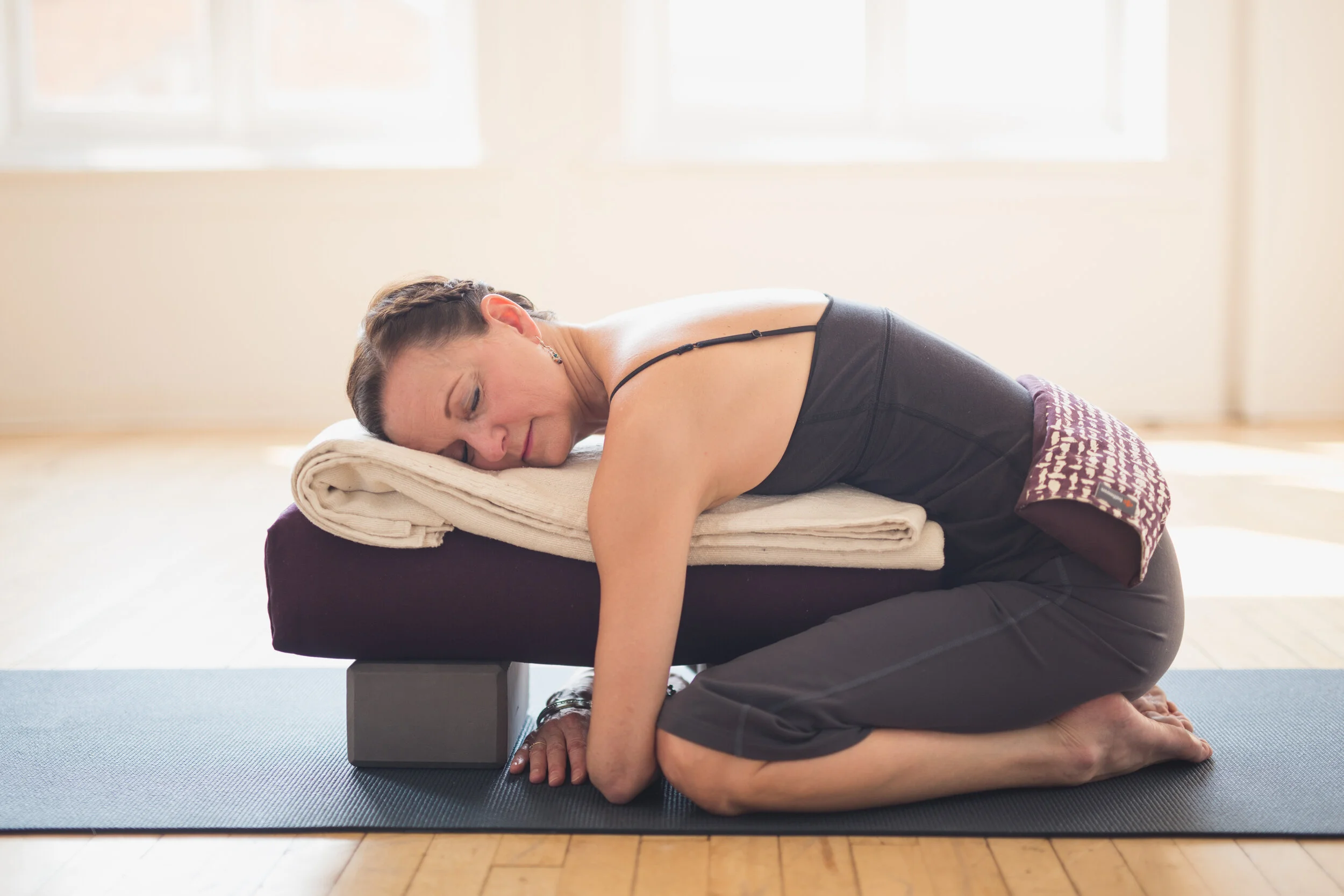
Repair your relaxation response by putting “energy back on the grid” with Supported Child’s Pose

Repair your relaxation response by putting “energy back on the grid” with Supported Child’s Pose